Tag: bariatric surgery

WHEN A CHILD IS PUNISHED FOR HER WEIGHT

WHEN A CHILD IS PUNISHED FOR HER WEIGHT

She is just 13 years old.Six months ago, she weighed 153 kilos. Today, after 6 months of bariatric surgery, she weighs 112 kg. She has lost 25% of her total body weight—a remarkable achievement by any medical standard. Physically, she’s doing better than ever. Emotionally, 

THE SILENT STRUGGLES

THE SILENT STRUGGLES

Yesterday, a 44-year-old man living with a weight of 182 kg broke down in tears during the consultation. He did not cry because he was in any kind of physical pain. He cried because he felt utterly helpless—and scared. He cried because he could no 

A PAGE FROM A DOCTOR’S DIARY

A PAGE FROM A DOCTOR’S DIARY

Together through every step

Seven years ago, Anaya walked into our clinic as a young, bubbly girl. She had struggled with obesity since puberty. She chose to undergo a bariatric surgery in the form of a laparoscopic sleeve gastrectomy and stepped into a new phase of life.

Yesterday, she came in for a follow-up consultation—a graceful woman, now married, a mother of two, and running her own business. Over the years, life has changed beautifully for her. But one thing hasn’t changed: her struggle with weight. Unlike many other health conditions, obesity is rarely understood. The frustration, the social pressure, the silent judgment—it can eat you up from inside.

Over the last 7 years, we have walked this journey together as a team—helping her through phases of weight regain after both pregnancies. This time, too, we helped her achieve her weight loss target. Our patients slowly become part of a larger family, and their victories, big or small, mean everything to us.

She told us about the joy and hope she regains with even a little progress, made possible through our support. And as she left, she said, “I really love you for all the support that you have given to me through the years.” Hearing that touched me deeply. It’s moments like these that make all the effort worthwhile.

This journey is not about numbers on a scale. It is about being understood, supported, and never left alone.

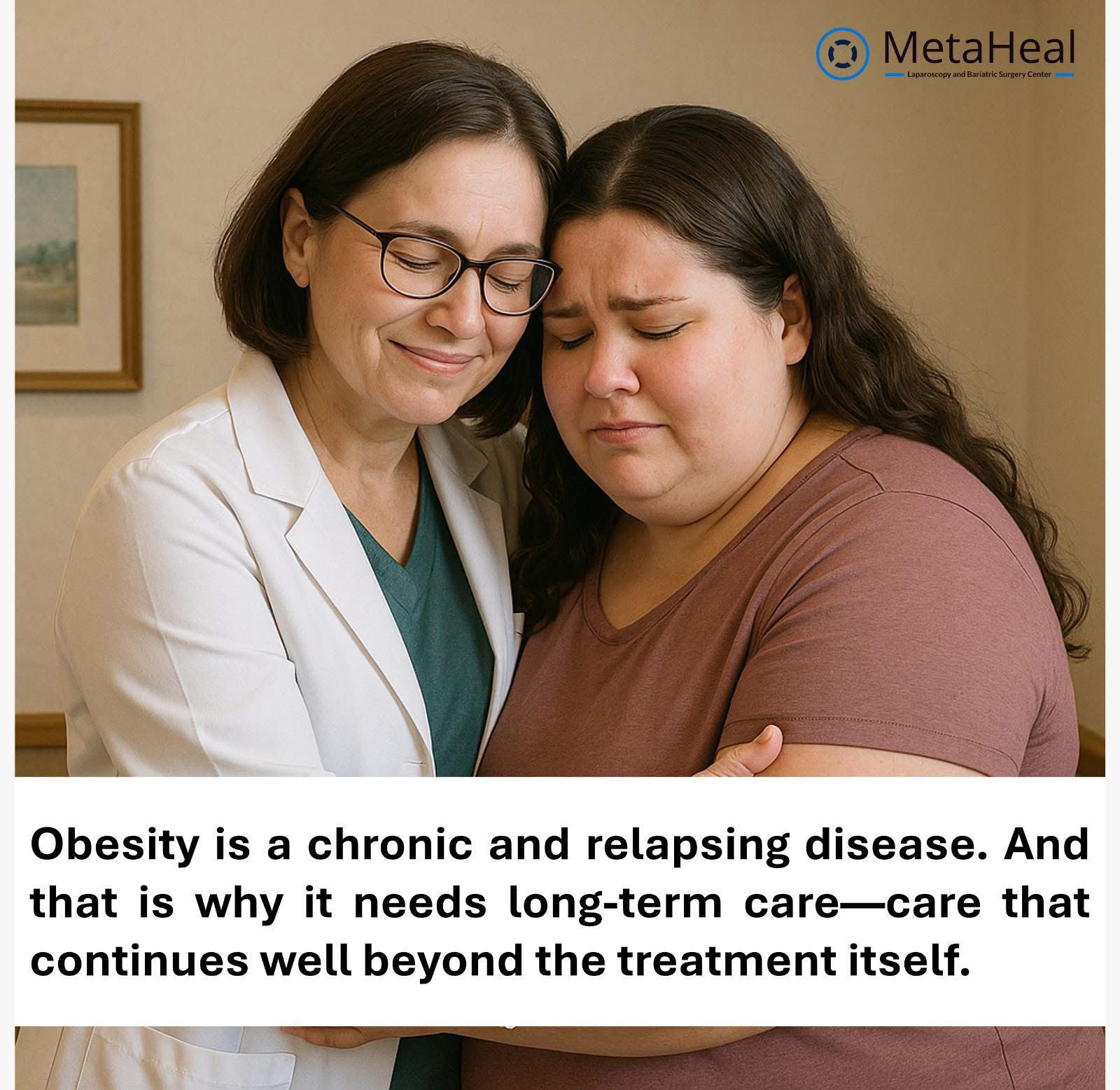
Obesity is a chronic and relapsing disease. And that is why it needs long-term care—care that continues well beyond the treatment itself.

©️Dr. Aparna Govil Bhasker

PS- The image is AI generated

The Unseen Struggles

The Unseen Struggles

©Dr. Aparna Govil Bhasker “I am continuously trying, but I feel like I’m constantly failing.” This was the first thing she said when we started talking about her weight issues. She was a 32-year-old working mother of a 16 months old baby girl, struggling with 

Beyond the prescription

Beyond the prescription

Beyond the prescription ©Dr. Aparna Govil Bhasker I’ve always enjoyed talking to my patients, and as much as I love surgery, I truly cherish my time in the OPD. However, the time available in the OPD is limited, and we need to cover a lot 

EMPATHY AND OBJECTIVITY- A DELICATE BALANCE

EMPATHY AND OBJECTIVITY- A DELICATE BALANCE

©️Dr. Aparna Govil Bhasker

As doctors, we love evidence-based medicine! Most of us believe in the old adage- “In God we trust. All others must bring data.” We are deeply impacted by impact factors and the graph of our pride rises in direct proportion to the number of times our research papers are cited in the literature. Today, we have journals sprouting by the dozens and thousands of research papers being published every year. We go around the world, brainstorming with colleagues and trying to make sense of these infinite numbers in an attempt to solve the mystery of human health and disease. Though we are always trying to apply the evidence to generate best practices, many times during heated discussions in conferences it all boils down to- “What would you do (WWYD) if this was your wife? WWYD if this was your mother? And saving the best for the last…… drumroll please!!….. WWYD if this was your (you guessed it right!) ….. mother-in-law?”

The biggest irony faced by medical practitioners is that while data guides clinical practice, statistics get severely skewed when viewed from the perspective of the patient and their family. The universally acceptable 0.1% adverse event rate is a one hundred percent catastrophe when the life of a loved one is on the line. Randomized controlled trials (RCT) fall terribly short when we have to break bad news to a patient’s family. Unfortunately, RCTs can’t feel the pain or the disappointment. In real life, numbers are just numbers and they have no feelings. At such times, emotions overrule evidence leading us back to the timeless question- “Doctor, what would you have done if this was your own family member?”

Medicine is probably the only profession with a direct impact on a person’s life and death. An average person would probably make life and death decisions once or twice in their entire life. Some may never have to do it at all. Doctors are professionals who have to make these difficult choices on a daily basis. We have to remain objective while everyone is panicking and remain calm in the midst of chaos. We have to keep our head on our shoulders and our heart tucked a little away. We are bound by oath to take risks on behalf of others. Well, we all know that taking a risk is a risky affair and things can go either way. We have the impolite job of being realistic and setting the expectations right. Sometimes we have to say things that people may not wish to hear. And sometimes when we say things, people may choose not to hear. At the end of the day, we have the challenging task of keeping hope alive too, for hope can be a stronger potion than any medicine in the world.

Striking a balance between objectivity and empathy is like navigating a ship through turbulent seas. If either side is lost or if there’s an excess of one, it could tip the balance and sink the ship. Published literature, studies, trials, data and numbers can at best guide clinical practice to some extent. However, rattling off numbers can never provide solace to a suffering family. The practice of medicine is beyond that and the healing potion must contain the right dose of empathy to be effective.

Some of us can overdose on empathy too. Excessive emotional involvement in every patient’s case can lead to burnout and compassion fatigue. Overwhelming empathy can be quite exhausting and we need some degree of professional detachment and objectivity to navigate the medical maze effectively. This brings me back to the WWYD question. Throughout my career, I’ve been taught to treat patients as I would my own family. While we hold our loved ones dear, treating every patient as kin would lead to an emotional roller coaster. Trust me, it’s not good for any of the stake holders.

The journey of a doctor is a delicate balance between objectivity and empathy. We begin our careers armed with a solid foundation in evidence-based medicine and data-driven practices. With experience, we come to appreciate the necessity of complimenting these with empathy and a profound understanding of the humane aspect of healthcare.

When science marries compassion, the journey of healing begins. Those who find this equilibrium our blessed and experience immense gratification and fulfilment in their professional lives. For others, it remains a work in progress. It’s challenging, yet attainable. It’s not easy, yet possible. It is a continuous journey of growth and learning, shaping us into better healers every day.


Using bariatric surgery to fight obesity

Using bariatric surgery to fight obesity

Dr. Aparna Govil Bhasker Bariatric and Laparoscopic Surgeon In the last week amongst the other patients I saw, there was one with a history of a stroke a few days back, one with a history of stroke, 2 years ago and a young lady with 

BARIATRIC SURGERY – Should Children Have It

BARIATRIC SURGERY – Should Children Have It

Dr. Aparna Govil Bhasker Bariatric and Laparoscopic GI Surgeon, Global Hospital, Parel; Apollo group of hospitals, Currae hospital, Thane; Namaha and Suchak Hospitals, Kandivali and Malad It is widely believed that the cohort of children born in the year 2000 in the USA, may live 

Quality versus Quantity Nutrition

Quality versus Quantity Nutrition

Author- Mariam Lakdawala (Registered Dietician)

Common questions I generally get from my patients suffering from obesity,

I don’t eat much, still why am I gaining weight?”

“I eat less than one of my friend, but why is she so thin and I am not?”

My answer to such questions is simple, “Don’t only see how much is on your plate, but also see ‘what’ is on your plate”.

The basic rule of weight loss is to restrict the overall quantity of food and increase the calorie burning capacity of the body. However, this rule has been outdated as only quantity restriction in the absence of food quality management, will not result in positive weight loss outcomes. Also a good quality diet which consists of good quantities of proteins and fiber keeps you full for longer and delays the intake of subsequent meal.

Though factors like genetics and heredity play a major role in adding those kilograms, ‘food’ can also be a major factor for tipping the scales towards obesity. If the quality of the diet is poor, food becomes the major cause of obesity. Your food plate determines the quality of your meals. An ideal food plate must have all the major (macro) nutrients i.e. carbohydrates (also includes fiber), proteins and fats in correct proportions.

weight loss diet in mumbai, india

In India, our diet is rich in carbohydrates with very less quantities of vegetables and proteins. This has an adverse impact on our metabolism and exposes us to various metabolic diseases, including obesity. In metropolitan cities the dependence on ready to eat processed foods like biscuits, breads, noodles, sausages/ nuggets etc is much higher in order to save time. These processed foods are generally high in sugars, salt and fat which makes them less nutritious and dense with empty calories. Poor quality diet coupled with lack of physical activity just makes it worse and has played a big role in increasing obesity levels.

The quality and quantity of food are two sides of the same coin. Both the aspects are equally important not only for weight loss but also for maintaining good health and must not be ignored.

How to manage Reactive Hypoglycemia?

How to manage Reactive Hypoglycemia?

Author- Mariam Lakdawala, Registered Dietician The most common observation made among diabetic patients is that they generally grab on sugar or sugary beverages when they get hypoglycaemic (a drop in the blood sugar levels). But are these sugar shots really helpful? Temporarily – yes, but