A PAGE FROM A DOCTOR’S DIARY
The Uterus Dialogues
Iska “uterus” to thik hai na? (Is her uterus alright?)
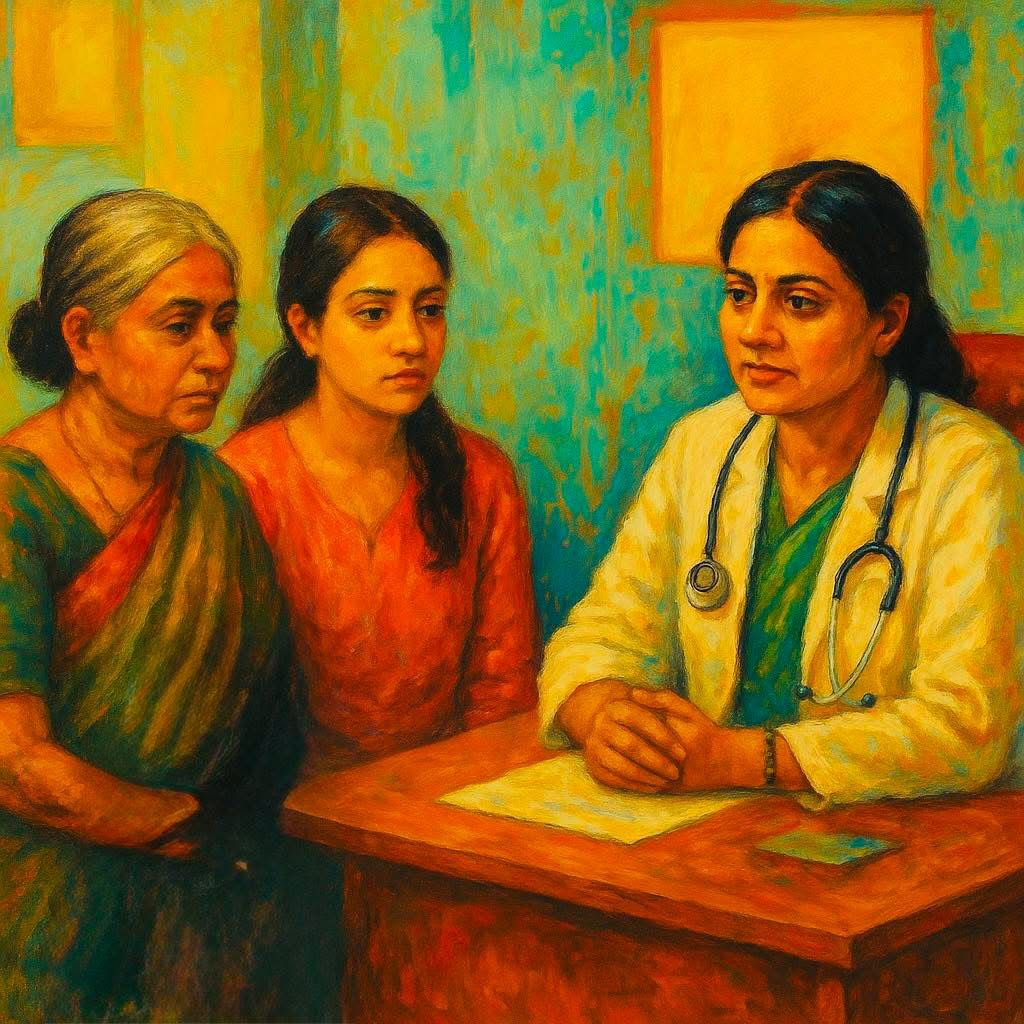
I am not a gynecologist. So, it took me a few moments to digest this question. It was thrown at me by a young patient’s mother who had accompanied her. For a few seconds, I was stumped and could not comprehend what exactly was being asked.
I paused for some time, still failing to understand.
I asked her again, “What do you mean?”
“I mean, is the uterus in good condition?” she reiterated.
As I looked at her, the person vanished, and a uterus replaced her in the chair across the table. I imagined a uterus with two dainty feet sitting cross-legged with a delicate bag and sunglasses, demanding a check-up from me. I guess her mother saw her the same way.
From her perspective, the uterus was the main character. The uterus would determine the future prospects of her daughter in our society. The uterus was not just a uterus; it was a guarantee of security, almost a status symbol.
If anything needed to be preserved with care in her daughter’s body, it was the uterus.
More than her heart, for what does the heart matter in practicality?
More than her mind, for women with their own mind are not an asset but a liability.
More than her soul, because who cares about it?
Now, most of you must be thinking that it is such an innocuous statement. Why am I making a big deal about it? What is so abnormal about a mother wanting to know about the condition of her marriageable daughter’s uterus? That is so normal.
But I guess nowadays the definition of normal has changed.
The abnormal has become so normal that it is almost abnormal to question it!
The uterus, as it appears, is a great equalizer in our society. It does not matter whether one is fair or dark, rich or poor, educated or uneducated, a working woman or a homemaker, financially dependent or independent; the uterus seems to take precedence irrespective of everything.
But should it?
Perhaps it is time we adjust that lens. A woman can not be defined by one organ. She is her mind, her spirit, her dreams, her compassion, and her contribution. The uterus is just a part of her story, but how can it be the whole?
I wish I could tell my patient’s mother that the uterus is the great paradox of a woman’s life. It is both the crown and the chain—hailed as her liberator, yet binding her in the very same breath.
The saddest part is that I know that deep down she probably knows it too.
©️Dr. Aparna Govil Bhasker